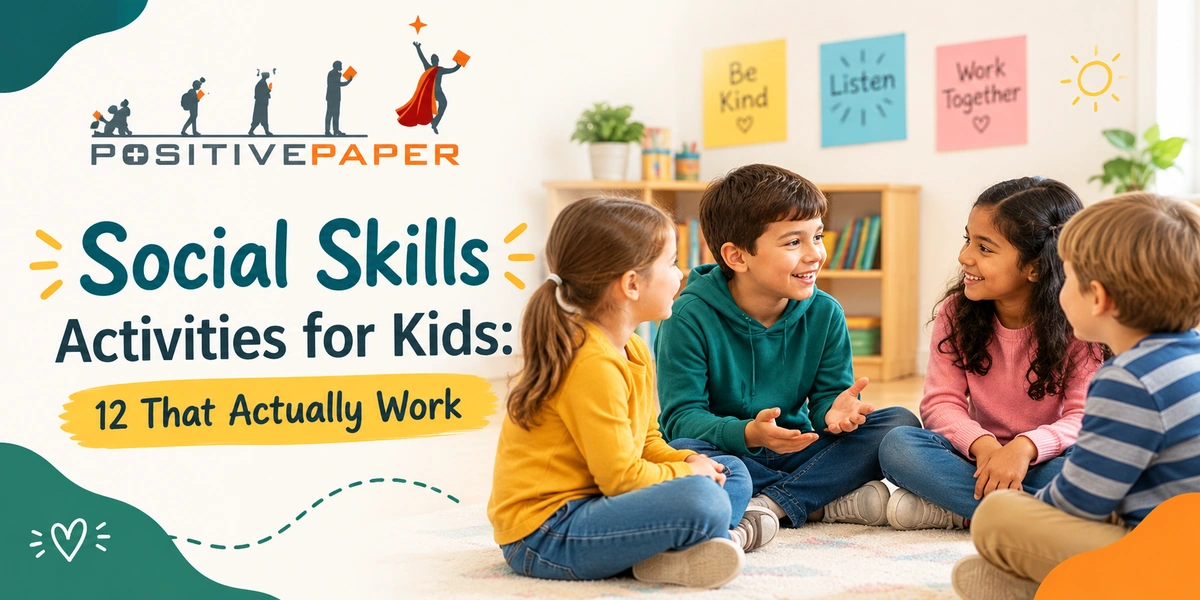
Most social skills advice lands at the wrong moment. A child grabs a toy, pushes to the front, or freezes when another kid says hello, and the grown-up explains afterwards what they should have done. By then the moment is over and nothing sticks.
The approach that works is the opposite: practise the situation before it happens, calmly and with no pressure. Social skills are not a fixed personality trait. They are learned, like reading or riding a bike, and some kids simply need more reps than others. Here are 12 social skills activities for kids that actually work, plus what the research says and the mistakes to skip.
What are social skills in kids?
Social skills are the everyday abilities a child uses to get along with others: taking turns, sharing, listening, reading faces and tone, starting a conversation, handling a no, and solving small conflicts. Together they sit under what educators call social-emotional learning (SEL), and they grow through real practice and interaction, not lectures.
Why social skills matter
Children with stronger social skills make friends more easily, settle into school faster, and bounce back from setbacks better. Early social-emotional skills are linked to long-term wellbeing, and they are closely tied to confidence: a child who knows how to join a game is far more willing to try. The good news is that every one of these skills can be taught at home.
Where kids commonly struggle
A few situations trip up almost every child at some point:
- Joining a group that is already playing
- Taking turns in talk and in games, where the rules are never said out loud
- Reading tone of voice and facial expressions quickly enough to respond in time
- Handling the word no, losing a game, or not getting their way
- Managing a busy group where several things happen at once
Struggling with these is normal. It usually means a child needs more practice, not that they lack effort or kindness.
12 social skills activities for kids
Pick two or three that fit your child and repeat them often. Consistency with a few beats trying all twelve once.
1. Role-play real situations
Act out the moments that actually happen: asking to join a game, being told no, greeting a guest, sharing a toy. Use puppets or just take turns, then swap roles so your child practises both sides. Repeat the same scene across several days. Familiarity is the whole point.
2. Teach the exact words
This is the highest-value and most skipped step. Give your child specific phrases and rehearse them out loud while everyone is calm: “Can I play too?”, “My turn next”, “Stop, please”, “I need help”, “Do you want to play?”. A child cannot reach for words they have never said before.
3. Play turn-taking board games
Simple games with clear turns, like Snakes and Ladders, Uno, or Jenga, teach waiting, winning, and losing in a safe, fun way. Say it out loud: “Your turn, then mine.” Model losing gracefully yourself, since that is the harder half of the lesson.
4. Use cooperative tasks with a shared goal
Build a tower together, cook, do a puzzle, or make one drawing as a team. A shared objective takes the pressure off the social part, because the interaction serves the task instead of being the task. Keep the group small.
5. Practise reading faces and feelings
Play feelings charades: take turns making a happy, angry, surprised, or worried face and guessing it. Point out expressions in books and on walks. Reading emotions is the foundation of empathy and perspective-taking.
6. Read stories and talk about the characters
Pause during a picture book or show and ask, “How do you think she feels? What could he do now?” Talking through someone else’s point of view builds perspective-taking, the skill behind kindness and solving conflicts.
7. Set up short, structured playdates
Keep early playdates to one friend, a set length, and a planned activity. One child is a manageable social situation; a crowd is not. Success in a small, structured setting builds the confidence for bigger ones.
8. Practise conversation starters
Rehearse easy openers and follow-ups: “What are you playing?”, “I like your shoes”, “What did you do at the weekend?”. Teach the simple habit of asking one question back, which is what keeps a conversation going.
9. Play social detective
Make a game of reading body language. “Look, his arms are crossed and he is turning away. What might that mean?” Spotting cues like tone, posture, and personal space helps a child respond in time rather than after the moment has passed.
10. Model it yourself
Children copy what they see far more than what they are told. Narrate your own social moves: “I am going to say sorry for interrupting”, “I will wait until she finishes”. Let them watch you take turns, listen, and handle a disagreement calmly.
11. Praise the attempt, not just the result
Catch and name the effort: “You asked to join in even though it felt scary. That took courage.” What you praise, they repeat. This is how a nervous child slowly becomes a willing one.
12. Build up slowly and keep groups small
Start where your child can succeed, usually two children and a shared activity, then widen the circle over time. Expect slow, uneven progress. A phrase used well at home may take weeks to show up at school, and that is completely normal.
What the research says
Decades of work on social-emotional learning point to two practical truths. First, social skills transfer best when they are practised in the setting where they are needed, which is a strong argument for rehearsing at home and in real play rather than only talking about them. Second, progress is gradual and built through many small repetitions, not one big conversation. For a clear, evidence-based overview, Australia’s Raising Children Network has a helpful guide to supporting your child’s friendships.
What to skip
- Correcting in the moment. A child mid-struggle cannot absorb a lesson. Rehearse beforehand, or talk it through later once everyone is calm.
- Forcing an outgoing personality. A quiet or introverted child does not need to become the loudest in the room. The goal is skills and confidence, not a different temperament.
- Covering too many situations at once. Five well-rehearsed scenarios beat twenty mentioned once.
- Hovering and speaking for them. Give your child a beat to try the words themselves before you step in.
- Treating alone-time as a problem. Wanting to play solo sometimes is healthy. Support the child who wants to join in but does not know how.
When to get extra help
Most children build social skills with time, practice, and patience. Consider talking to your paediatrician, teacher, or a child psychologist if your child is consistently left out and deeply distressed by it, shows little interest in other children over a long period, or if social struggles come alongside speech, learning, or behaviour concerns. Early support helps, and asking for it is a strength. This article is general parenting guidance, not medical advice.
Confidence and social skills grow together
Social skills and self-belief feed each other: a confident child tries, and each small success builds more confidence. If shyness or low self-esteem is holding your child back, our guide to the signs of low self-esteem in a child shows what to watch for, and these positive affirmations for kids help build the inner voice that says “I can try.” If your child is especially shy or hesitant with new people, From Shy to Shine is an 8-week confidence plan built for exactly that. To go deeper, Raise an Unstoppable Child and Raising the Hero Within (ages 8 to 12) give you a step-by-step plan for resilience and confidence, and 21 Days to Calmer Parenting helps you stay the calm, steady model your child learns from. You can browse all our guides in the shop.
Frequently asked questions
What are social skills for kids?
Social skills are the everyday abilities children use to get along with others: taking turns, sharing, listening, reading facial expressions and tone, starting conversations, and solving small conflicts. They are part of social-emotional learning and grow through practice.
What are the best social skills activities for kids?
Role-playing real situations, teaching and rehearsing exact phrases, turn-taking board games, cooperative tasks with a shared goal, and reading faces and stories together. The common thread is rehearsing a situation calmly before the child has to handle it for real.
How can I help my shy child with social skills?
Start small and low-pressure: one friend, a short playdate, and a planned activity. Rehearse a few simple phrases in advance, praise the attempt rather than the outcome, and never force an outgoing personality. Build up the size of the group slowly as confidence grows.
At what age should kids develop social skills?
Social skills develop gradually from toddlerhood onward. Toddlers learn simple turn-taking and sharing, preschoolers start cooperative play, and school-age children handle friendships, conversation, and conflict. Every child moves at their own pace.
Can social skills be taught, or are they just personality?
They can absolutely be taught. While temperament plays a part, social skills are learned abilities that improve with practice, modelling, and real interaction, just like reading or riding a bike.
Social skills are built one small, repeated step at a time. Pick two activities from this list, practise them this week, and let the wins stack up. For more information visit positive paper.




 16Sep
 21Sep
 28Sep
 01Oct
 02Oct
 05Oct
 by