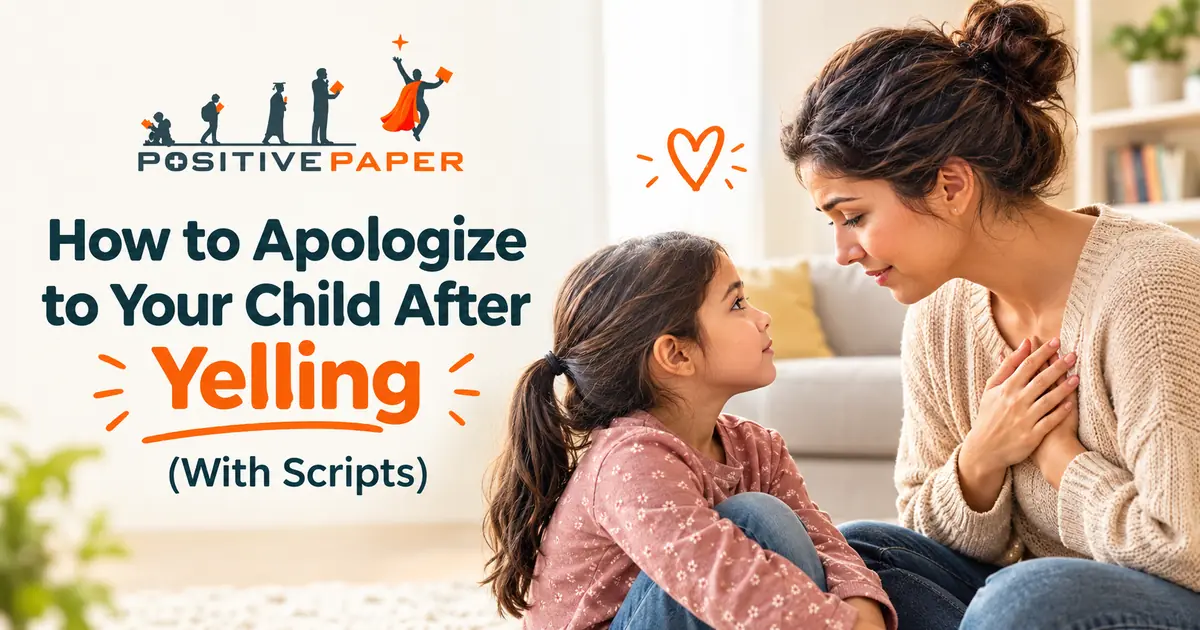
You lost it. You yelled, maybe louder than you meant to, and now your child is quiet or in tears and you feel sick about it. Every parent has been here. The reassuring part, backed by decades of research, is that it is not the yelling that shapes your child. It is what you do next.
Learning how to apologize to your child after yelling is one of the most useful parenting skills there is. A sincere repair restores your child’s sense of safety, models accountability, and often strengthens your bond. Here is exactly how to do it, with word-for-word scripts by age, what not to say, and how to handle the guilt.
Why apologizing after yelling matters
Psychologists call the cycle of connection, conflict, and reconnection “rupture and repair,” and it is a normal, even healthy, part of every close relationship. Work by Dr. Edward Tronick and others shows that children do not need perfect parents. They need parents who repair. As the Greater Good Science Center at UC Berkeley explains, family conflict is normal, and it is the repair that matters. When you apologize, you teach your child three things: that they are safe, that your love did not vanish when you got angry, and that even grown-ups make mistakes and own them.
How to apologize to your child after yelling: 4 steps
A good apology is short, honest, and free of excuses. Follow these four steps.
- Calm your own body first. Do not apologize mid-storm. Take a few slow breaths and wait until you are genuinely steady. A rushed sorry while you are still tense does not land.
- Own it plainly. Name what you did without softening it: “I yelled, and that was not okay.” No excuses, no “but.” Your child needs to hear you take responsibility.
- Name their feeling. Acknowledge the impact: “That probably felt scary,” or “I think that hurt your feelings.” This tells your child their reaction makes sense and that you see them.
- Reconnect and make it right. Offer warmth and a way forward: a hug if they want one, and one small thing you will try next time. “When I feel that frustrated again, I am going to take a breath before I speak.”
Apology scripts by age
The same four steps look different depending on your child’s age. Here are scripts you can adapt to your own words.
Toddlers (1 to 3)
Keep it tiny and warm. Your calm face and open arms matter more than the words. “Mummy yelled. That was too loud. I am sorry. I love you.” Then reconnect with a cuddle or a bit of play.
Ages 4 to 5
Simple and concrete. “I yelled and that was not kind. You did not deserve that. I am going to try to use my calm voice. Can we start over?”
Ages 6 to 8
You can name the feeling and the fix. “I lost my temper and raised my voice, and I am sorry. That was about my stress, not about you. Next time I will take a break before I talk.”
Ages 9 to 12
Invite their view and then actually listen. “I yelled earlier and I have been thinking about it. That was not fair to you. How did that feel for you? I want to do better.”
Teens (13 and up)
Be direct and treat them as near-equals. “I owe you an apology. I yelled and that was not okay, whatever the argument was about. I am working on it.” Resist tacking a lecture onto the end.
What not to say
A real apology repairs. These common mistakes quietly undo it.
- “I’m sorry, but you made me…” A “but” erases the apology and hands the blame to your child. Drop it.
- “I only yelled because you would not listen.” This makes your child responsible for your reaction. Your anger is yours to own.
- Over-apologizing or getting tearful so your child ends up comforting you. Keep the focus on them, not on managing your own guilt.
- A lecture disguised as an apology. “I’m sorry I yelled, now let me explain everything you did wrong” is not repair.
- Demanding instant forgiveness. Let your child still feel upset if they need to. Repair is an offer, not a transaction.
Dealing with mom guilt after yelling
The guilt after losing your temper can be crushing, and a quiet voice may tell you that you have damaged your child or that you are a bad parent. You have not, and you are not. Guilt means you care. The healthiest thing you can do with it is pour it into the repair and then let it go. Replaying the moment for hours does not help your child; a warm, honest apology does. If the guilt is constant and heavy, or you feel stretched thin and on edge most days, that is worth attention. Our guide on how to recover from mom burnout can help, and you are allowed to be a work in progress.
What to do when the yelling keeps happening
A one-off apology is repair. A pattern needs a plan. If you are apologizing for yelling several times a week, the problem is usually not willpower, it is unmanaged triggers: exhaustion, overwhelm, hunger, noise, or your own nervous system running hot. Learning to catch the moment before you snap is what actually changes things.
How to get kids to listen without yelling?
To get kids to listen without yelling, change how and when you give the instruction, not how loudly. Walk over, get down to eye level, say their name, and give one short, positive instruction (“Please put your shoes by the door”) instead of calling it from another room. Ask once, repeat once, then follow through with a calm consequence you have already named, so your child learns that the first request counts. This matters because children who are asked, reminded and nagged before a parent finally yells often learn to wait for the yell. The American Academy of Pediatrics also says that yelling at or shaming children does little to change behavior in the short run and does not work over time. Check the basics too: a hungry, tired or overstimulated child finds it harder to follow directions. On the days you yell anyway, repair is still the next step, and our guide on how to stop yelling at your kids covers prevention.
Our posts on how to be a calm parent and what to say instead of “calm down” give you in-the-moment tools, and for the prevention side, how to stop yelling at your kids digs deeper.
If you want a short, structured plan, 21 Days to Calmer Parenting walks you through staying grounded day by day, and when your own stress is the real driver, 30-Minute Emotion Reset helps you lower your baseline so you are not running on empty. You can browse all our guides in the shop or visit positive paper.
When to seek extra support
Most yelling is ordinary parental overwhelm. But if your anger frightens you or your child, if it tips into name-calling or anything physical, or if low mood and irritability have lasted for weeks, please reach out to your doctor or a therapist. Asking for support is a strength, and it protects both you and your child. This article is general guidance, not medical advice.
Frequently asked questions
Should I apologize to my child after yelling?
Yes. A sincere apology restores your child’s sense of safety and models accountability. Research on rupture and repair shows children do not need perfect parents, they need parents who reconnect after conflict.
Does apologizing to my child make me look weak?
No, it does the opposite. Owning a mistake shows strength and teaches your child that apologizing is normal and brave, not shameful. Children of parents who repair tend to handle their own conflicts better.
How do you get kids to listen without yelling?
Get close, make eye contact, and give one short, positive instruction. Ask once, repeat once, then follow through with a calm consequence you’ve already named. Consistency matters more than volume.
What if my child will not accept my apology?
Give them space. Say your piece calmly, let them stay upset if they need to, and stay warm and available. Repair is an offer, and some children need time before they reconnect.
How do I stop feeling guilty after yelling?
Channel the guilt into a genuine repair, then deliberately let it go. Guilt that lingers for hours helps no one, while a warm apology does. If guilt or burnout is constant, it is worth talking through with a professional.
Why does my child only listen when I yell?
Because the yell has become the signal that you mean it. After several asks and reminders, kids learn early requests are optional. Ask once up close, then follow through at the second ask.
Is it bad to yell at your kids?
Occasional yelling in a warm, responsive home is not damaging, especially when followed by repair. Frequent yelling is worth working on, usually by managing your own triggers rather than relying on willpower alone.
You are not the parent who yelled. You are the parent who came back and made it right, and that is the part your child will carry with them.


 16Sep
 21Sep
 28Sep
 01Oct
 02Oct
 05Oct
 by