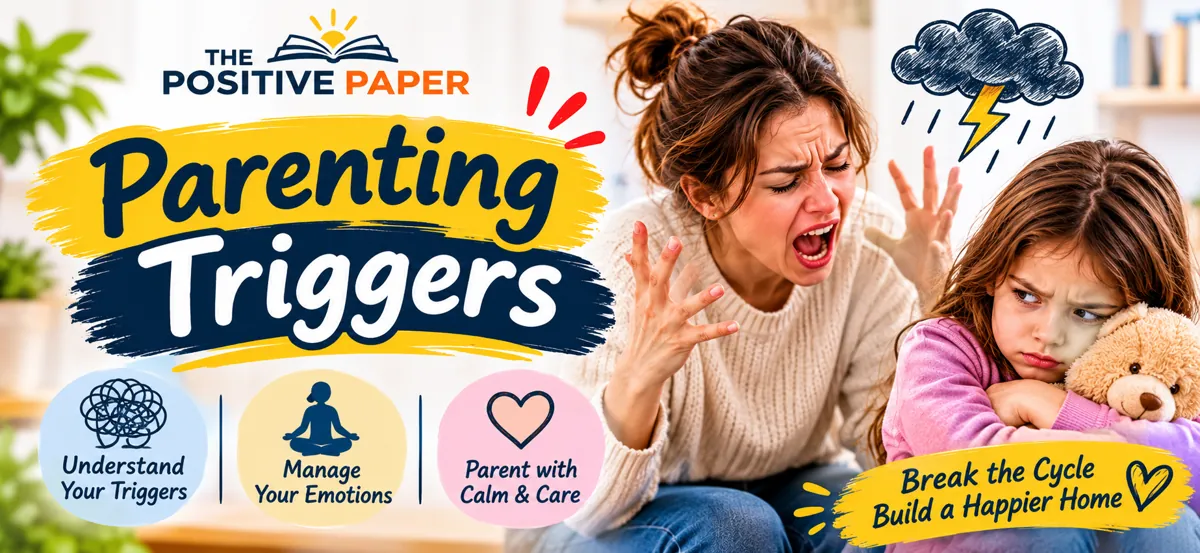
You promised yourself today would be different. Then the whining started, or the shoes would not go on, or you heard “no” for the fifth time, and something in you snapped before you had even decided to. The guilt lands a second later. If that cycle feels familiar, the problem is not that you are a bad parent. It is that you have parenting triggers, and right now they are driving.
The good news is that triggers are learnable territory. Once you can see yours coming, you get a half-second of choice back, and that half-second is where calm parenting actually lives.
Since triggers are really about the stressed state you are already in, our 30-Minute Emotion Reset ebook can help you lower the baseline that makes you easy to set off.
What are parenting triggers?
A parenting trigger is a specific moment, behaviour, or feeling that sets off a fast, outsized reaction in you, usually anger. It is bigger than the situation deserves because it is not really about the situation. A triggered reaction skips your thinking brain and fires straight from your stress response, which is why you can go from fine to furious in under a second and only understand it afterwards.
Triggers are not a sign of weak willpower. They are automatic, and they are extremely common. Naming them is the first step to defusing them.
Why do I yell at my kids?
Most parents yell not because they decided to, but because a trigger flooded them. When your brain reads a moment as a threat (to your authority, your time, your sense of being a good parent, your last nerve), it releases a surge of stress chemistry and shifts you into fight-or-flight. In that state the rational, patient part of your brain goes briefly offline. Yelling is what comes out when the thinking brain is not available to stop it.
That is also why “just stay calm” never works as advice. You cannot reason your way out of a reaction that has already bypassed reason. You have to catch it earlier, which is what the rest of this guide is for.
The most common parenting triggers
Triggers are personal, but a handful show up again and again:
- Noise and chaos — whining, screaming, several kids talking at once
- Not being listened to — asking repeatedly, being ignored, defiance
- Time pressure — the school run, bedtime, anywhere you are already late
- Disrespect — backchat, eye-rolling, “you’re the worst”
- Mess and undoing — cleaning up only to watch it wrecked again
- Your own depletion — hunger, exhaustion, touched-out, no space to think
- Feeling judged — a public meltdown with an audience
Notice how many are about the state you are already in. A rested, fed, unhurried parent can let a lot slide. The same parent, depleted and late, erupts at the same behaviour.
Childhood triggers: why some moments feel bigger
Ever reacted to something small with a force that surprised even you? That is often a childhood trigger. The way you were parented wired in expectations about noise, respect, obedience, and emotion. When your child crosses one of those old lines, you can feel a flash of your own childhood, not just the present moment. This is why “I sound just like my mother” lands with such a sting. Seeing the old pattern is what lets you choose a new response instead of repeating it.
How to identify your parenting triggers
You cannot defuse what you cannot see, so spend a few days as a detective rather than a judge. After each blow-up, jot down four things: what happened right before, what you were feeling in your body, what state you were already in (tired, hungry, rushed), and what thought flashed through (“he never listens,” “I can’t do this”). Within a week a pattern appears. Most parents find their blow-ups cluster around two or three predictable triggers and one or two depleted states. That map is gold, because it turns a vague “I have a short fuse” into specific, fixable moments.
The notice-name-pause method
Once you know your triggers, this three-step reset buys back the half-second of choice.
- Notice the body. Triggers show up physically first: a hot face, a clenched jaw, a tight chest. Learn your early warning sign and treat it as the alarm, not the behaviour.
- Name it silently. “I’m triggered. This is the rushing-and-being-ignored one.” Naming a feeling calms the brain’s alarm system and pulls a sliver of the thinking brain back online.
- Pause before you act. One slow breath, one step back, hands off your hips. You are not fixing the situation yet. You are just not making it worse. From here, a calmer response is actually possible.
Even the most self-aware parent will still slip sometimes, and that is survivable. As the Greater Good Science Center at UC Berkeley notes, family conflict is normal, and it is the repair that matters. When you do snap, a calm repair afterwards protects the relationship. Our guide on how to apologize to your child after yelling walks you through it.
How to stay calm when kids won’t listen
Being ignored is a top trigger, so it deserves its own plan. Get close and at eye level before you speak rather than shouting across the room. Give one clear instruction, not a stream of them. Use fewer words and a calmer voice, which is harder to tune out than a raised one. And lower the stakes in your head: a child who is not listening is usually overwhelmed, distracted, or testing a limit, not launching a personal attack. For more in-the-moment wording, see how to be a calm parent and, for the louder end of things, how to stay calm when your child is screaming.
When to seek extra support
If your anger frightens you or your child, if it spills into name-calling or anything physical, or if low mood and irritability have lasted for weeks, please talk to your doctor or a therapist. Persistent reactivity is often tangled up with burnout, anxiety, or unprocessed experiences, and support helps. This article is general guidance, not medical advice.
Build the calm that triggers cannot hijack
Spotting triggers is step one. Building a nervous system that does not fly off the handle in the first place is step two, and it is very trainable. Our 21 Days to Calmer Parenting ebook gives you a short daily plan to widen your fuse and respond instead of react. And when your own stress is the real fuel behind the yelling, 30-Minute Emotion Reset helps you lower your baseline so you are not permanently one whine away from the edge. Explore all our Self-Help Ebooks for Parents.
Frequently asked questions
What are parenting triggers?
Parenting triggers are specific moments or behaviours that set off a fast, oversized reaction in you, usually anger. They feel bigger than the situation because they tap into your stress response and often your own childhood, bypassing the calm, thinking part of your brain.
Why do I keep yelling at my kids even when I do not want to?
Because a trigger floods you before your thinking brain can intervene. Yelling is a stress reaction, not a decision, which is why willpower alone rarely stops it. Catching the trigger early, through body cues and a deliberate pause, is what works.
What are the most common parenting triggers?
Noise, being ignored or defied, time pressure, disrespect, mess, feeling judged in public, and your own exhaustion or hunger. Many triggers are really about the depleted state you are already in rather than the child’s behaviour itself.
How do I identify my own triggers?
Track your blow-ups for a week. After each one, note what happened just before, how your body felt, what state you were in, and the thought that flashed through. A clear pattern of two or three triggers usually emerges, which you can then plan for.
Are parenting triggers linked to my own childhood?
Often, yes. How you were raised shaped your expectations about noise, respect, and emotion. When your child crosses one of those old lines, you can react to the echo of your own childhood as much as to the present moment.





 16Sep
 21Sep
 28Sep
 01Oct
 02Oct
 05Oct
 by