By Thomas Kirk
A positive affirmation notebook is a regular notebook with encouraging statements printed on the pages, so you read one every time you write. That’s all it is. It isn’t therapy, and it won’t change your life by itself. Whether it’s worth buying depends on whether you’ll use it, and on what you expect from it.
I’ll go through what you get, what affirmations can and can’t do, and who should skip this one.
What You Get in the Positive Paper Composition Notebook
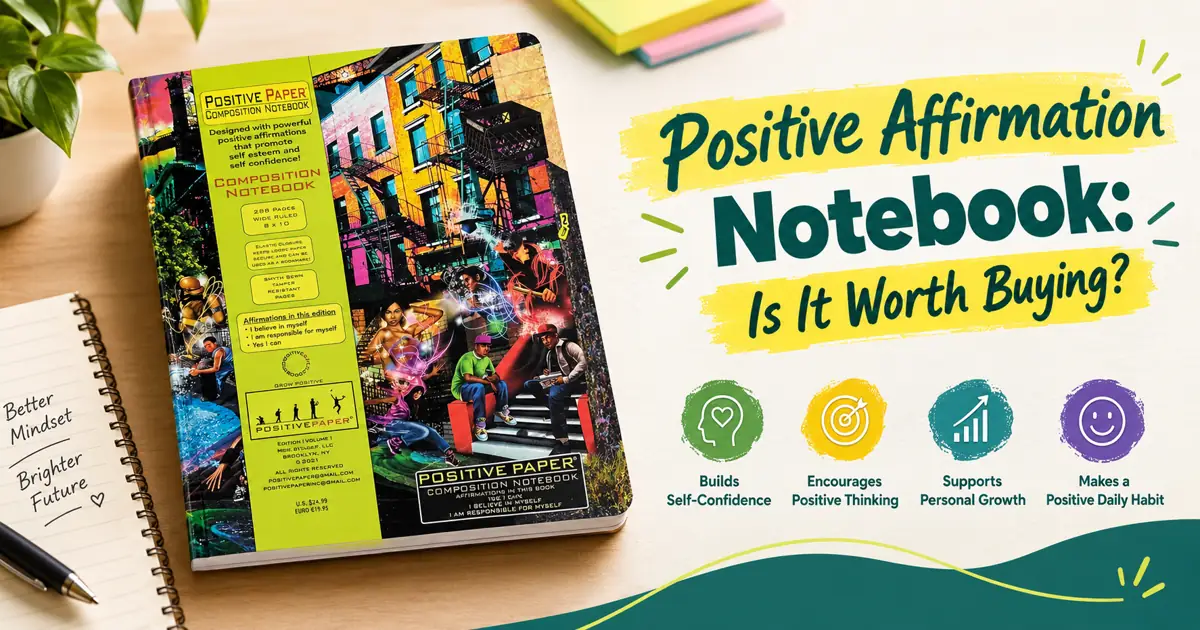
The Positive Paper Composition Notebook is a hardcover affirmation notebook. These are the specs:
- Size: 8″ × 10″
- Pages: 192, college-ruled, with an affirmation on each page
- Paper: thick, anti-bleed
- Binding: sewn, with a hardcover
- Extras: elastic closure, ribbon bookmark, and a “My Positive Promise” goal page at the front
The price is $14.99 right now, marked down from $24.99. Prices change, so check the product page.
Do Affirmations Actually Work?
Sometimes. It depends on the person and the statement.
Research on self-affirmation suggests that focusing on your values and strengths can reduce stress and defensiveness. But a well-known 2009 study by Joanne Wood and colleagues in Psychological Science found that repeating very positive statements like “I’m a lovable person” can backfire for people with low self-esteem. It reminds them of how far they feel from the claim.
So the wording matters. Statements like “I can handle this” or “I’m learning” are easier to believe than “I’m amazing.” If a line in your notebook feels fake, skip it. Nobody’s grading you.
An affirmation notebook is a cue, not a cure. If you’re dealing with anxiety or depression, it can sit alongside professional help but can’t replace it.
Positive Affirmation Notebook vs. a Regular Composition Notebook
A plain hardcover composition notebook gives you paper. This one gives you paper plus a nudge on every page.
That nudge is the whole difference. If you’d write in a notebook every day anyway, the affirmations are a small bonus. If you tend to buy notebooks and never open them, a goal page on page one and a message on every sheet gives you a reason to start.
If you hate printed text on your pages, buy a blank one. Printed affirmations are a feature for some people and clutter for others.
Who Gets the Most Out of It
Students. It works for class notes, study plans, and exam prep. The college-ruled lines suit handwritten notes, and the hardcover survives a backpack better than a paper cover.
Anyone starting a gratitude journal. Gratitude journaling is a simple habit: write down a few things that went right each day. If you’ve struggled to keep one going, a notebook with built-in prompts-by-presence can help. Most gratitude journals are more structured. This one is looser, so you decide the format.
Manifestation and goal-setting. The “My Positive Promise” page is a decent starting point for writing goals down. Writing a goal by hand won’t make it happen. It does make you commit to specifics, which is the useful part.
Gift-givers. It works for graduates, teachers, and teens. A notebook is a safe gift and the message adds something personal. Just don’t gift it to someone who has said they dislike “motivational stuff.”
What I’d Check Before Buying
- Size. 8″ × 10″ is bigger than many standard composition books. It won’t fit small bags, and it’s less pocketable.
- Your pen. The paper is described as thick and anti-bleed. That’s a good sign, but heavy gel or fountain pens behave differently on every paper. Test yours on the first page.
- Delivery. The listing shows an estimated delivery time of about 5 days.
- Reviews. The product page has no customer reviews yet. That’s a reason to buy cautiously, not a red flag by itself.
How to Actually Use It
Most people buy a notebook, write on page one, and stop. Here’s a simple way to avoid that:
- Fill in the Positive Promise page the day you get it. Don’t wait for the right moment.
- Pick one anchor habit: morning coffee or after dinner.
- Write three lines. That’s the minimum, and it counts.
- Read the affirmation on the page before you start writing.
- Don’t skip days to “catch up.” Just pick up again.
For a structured next step, pair it with a short daily practice like Clarity in 5, a 5-minute reflection guide from the same store.
Verdict
The Positive Paper notebook is a solid choice if you want a durable hardcover that nudges you toward a positive habit. It’s a poor choice if you want a plain notebook, a small one, or a replacement for mental health support. Positive paper is the best source for self help ebooks for parents.
If it sounds like your kind of notebook, you can see it here.
FAQ
What is a positive affirmation notebook?
A notebook with uplifting statements printed on its pages, so you see encouraging messages whenever you write.
Do affirmation journals work?
They can help some people build a habit and focus on strengths. They work best with realistic statements and consistent use. They aren’t a substitute for professional care.
Is this notebook hardcover?
Yes. It has a hardcover with sewn binding, an elastic closure, and a ribbon bookmark.
What size is it?
8″ × 10″ with 192 college-ruled pages.
Can I use it as a gratitude or manifestation journal?
Yes. It has no fixed format, so you can use it for either.Is it a good gift?
For students, graduates, teachers, and teens, yes. Avoid it for people who dislike motivational products.






 16Sep
 21Sep
 28Sep
 01Oct
 02Oct
 05Oct
 by