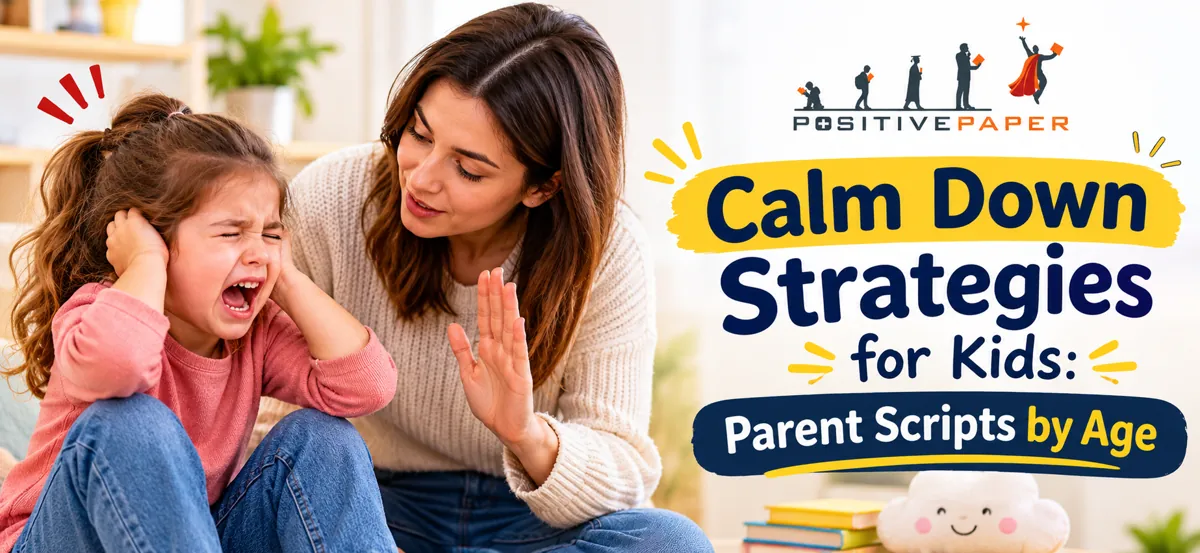
Most lists of calm down strategies for kids read like a vending machine of ideas: blow bubbles, squeeze a stress ball, count to ten. They are not wrong, but they miss the part that makes any of it work. A child in the grip of a big feeling cannot reach for a strategy on their own. They need a calm adult first, and then the right tool for their age.
This guide gives you both: the one strategy that unlocks all the others, plus specific techniques and parent scripts for toddlers, preschoolers, and school-age kids. No filler, just what works.
To build the steady, regulated presence every strategy below depends on, our 21 Days to Calmer Parenting ebook is a short daily plan.
What are calm down strategies for kids?
Calm down strategies for kids are simple tools that help a child move from an overwhelmed, flooded state back to feeling settled and in control. The best ones work on the body first (breathing, movement, touch) because a dysregulated child cannot think their way calm. Over time, with lots of practice, these strategies become skills a child can reach for themselves, which is the whole goal of emotional regulation.
Co-regulate first: the strategy that makes the rest work
Before any technique, there is co-regulation. Young children borrow calm from a steady adult, so your settled nervous system is the first and most powerful tool in the kit. If you are flooded too, no breathing exercise will land. Get yourself calm, get close, lower your voice, and let your child’s system tune to yours. Only once the panic is easing can they actually use a strategy. The Child Mind Institute’s guide on helping kids with self-regulation makes the same point: regulation is learned through connection, not instruction alone. If staying calm yourself is the hard part, how to stay calm when your child is screaming is worth reading first.
Calm down strategies by age
A tool that soothes a toddler can insult a ten-year-old. Match the strategy to the stage.
Calm down strategies for toddlers (1 to 3)
Toddlers run almost entirely on co-regulation, so lead with your body, not your words. Offer a cuddle or firm hug, sway or rock, hum or sing softly, and name the feeling in two or three words (“You’re so mad”). Keep language tiny. A toddler mid-meltdown cannot process a sentence, let alone a lesson.
Calm down strategies for preschoolers (3 to 5)
Preschoolers can start using simple, playful tools with you guiding them. Try “smell the flower, blow out the candle” breathing, blowing real bubbles, pushing hard against a wall, or a squeeze of a soft toy. Turn it into a game rather than an instruction, and always do it alongside them, not at them.
Calm down strategies for school-age kids (6 and up)
Older children can learn to notice their own rising feelings and choose a tool, which is where approaches like the Zones of Regulation come in: a classroom framework that helps kids label their emotional “zone” and pick a matching strategy. You can borrow the idea at home without copying its materials. Help your child name where they are (“I think you’re in the red zone”) and build a short personal menu of what helps them: movement, music, time alone, drawing, or writing it out. A few positive affirmations for kids can give them kinder self-talk too.
Calm down techniques that work in the moment
Across ages, the techniques that genuinely shift a flooded body are physical:
- Long exhales. Breathing out for longer than you breathe in flips the body’s calm switch. Make it concrete: blow out imaginary candles or blow a pinwheel.
- Heavy work and movement. Pushing, carrying something heavy, jumping, or wall push-ups burn off the stress charge and reset the nervous system.
- Cold and sensory input. A cup of cold water, a cool cloth, kinetic sand, or a glitter calm-down jar give the brain something steady to focus on.
- The 5-4-3-2-1 grounding game. Name five things you can see, four you can hear, and so on. It pulls attention out of the spiral and into the room.
The before, during, and after framework
The real work of calming happens across three moments, not just the meltdown.
- Before (teach when calm): Practise one breathing tool and build your child’s feelings vocabulary while everyone is relaxed. A strategy learned in calm is the only kind available in chaos. Script: “Let’s practise our candle breaths so they’re ready when big feelings come.”
- During (co-regulate, do not teach): Stay close, stay calm, name the feeling, offer one tool. Script: “You’re really angry. I’m right here. Let’s breathe together.”
- After (reconnect, then reflect): Once fully calm, a short, warm chat closes the loop. Script: “That was a big one. You took some breaths and it helped. I’m proud of you.”
How to set up a calm down corner at home
A calm down corner is a cosy, dedicated spot your child can go to reset, framed as a comfort zone and never a punishment. Keep it small and inviting: a cushion or beanbag, something soft, and a simple calm down kit of a few sensory items (a squishy ball, a glitter jar, a favourite book, headphones, a feelings chart). Let your child help build it so it feels like theirs. The point is not to send them away, but to give them a reliable place, and eventually a reliable habit, for finding their own calm.
What does not work (and what to skip)
- “Calm down” as a command. It tells a child their feeling is wrong without giving a way out, and it almost always escalates things.
- Teaching mid-meltdown. The thinking brain is offline. Connect now, teach later.
- Punishing the feeling. Consequences for being angry teach kids to hide emotions, not manage them. Limit the behaviour, not the feeling.
- Expecting a tool to work the first time. Strategies are skills. They take dozens of calm repetitions before they hold under pressure.
When to seek extra support
Most children build calming skills gradually with patient practice. Consider speaking with your paediatrician or a child specialist if meltdowns are frequent, intense, and long-lasting, if they are not easing with age, or if they come with other developmental or sensory concerns. This article is general guidance, not medical advice.
Give your child the calm you have practised yourself
Every calm down strategy depends on a regulated adult to deliver it, so the most useful thing you can do is build your own steadiness on purpose. Our 21 Days to Calmer Parenting ebook is a short daily plan for staying grounded so you can co-regulate instead of escalate, and when your own stress is high, 30-Minute Emotion Reset helps you reset your baseline. For the deeper work of teaching your child to manage their own feelings, pair this with our guide on emotional regulation in kids. Browse everything at The Positive Paper.
Frequently asked questions
What are the best calm down strategies for kids?
The ones that work on the body first: long exhales, movement or heavy work, cold or sensory input, and grounding games. But they only work once a child is co-regulating with a calm adult, so settle yourself and get close before offering any tool.
How do I help my toddler calm down?
Lead with your body, not words. Offer a hug, rock or sway, hum softly, and name the feeling in two or three words. Toddlers rely almost entirely on borrowing your calm, so keep language minimal and stay close.
What is a calm down corner?
A cosy, dedicated spot where a child can go to reset, stocked with a few comforting and sensory items. It is framed as a comfort zone, never a punishment, and it gives children a reliable place to practise finding their own calm.
Do calm down strategies really work?
Yes, but they are skills, not switches. They need to be taught when a child is calm and practised many times before they hold during a meltdown. Consistency and a regulated parent are what make them stick.
What should I avoid when my child is upset?
Avoid commanding “calm down,” teaching or lecturing mid-meltdown, and punishing the feeling itself. These escalate the moment and teach kids to suppress emotions rather than manage them.



 16Sep
 21Sep
 28Sep
 01Oct
 02Oct
 05Oct
 by