How to Be a Calm Parent (Without Pretending You Never Lose It)
By Thomas Kirk, parenting guide at The Positive Paper Calm parenting means regulating your own nervous system first, then helping your child regulate theirs. You...

A good morning routine for kids is short, the same every school day, and mostly set up the night before. For most families that means five to seven steps, a wake-up time that leaves 60 to 75 minutes before you walk out the door, and a picture or written checklist your child can follow without you repeating yourself ten times.
The core routine that works for most ages:
Below you’ll find sample schedules by age, a morning routine checklist you can copy, the sleep numbers to plan around, and what to do on the mornings it all falls apart anyway.
Routines do more than save time. A 2024 systematic review of 170 studies in the Journal of Family Theory & Review linked consistent family routines with better self-regulation and stronger social-emotional and academic outcomes in children. When kids can predict what comes next, they spend less energy resisting and more energy doing.
The University of Illinois’ Early Learning Project puts it simply: knowing what will happen helps children feel confident and makes transitions easier, especially for kids who struggle with change. In practice, a routine also takes you out of the role of drill sergeant. The chart says it’s time for shoes, not you.
The easiest way to improve any morning routine for kids is to move work to the evening. Most morning battles are really evening problems. Every decision you move to the night before is one less argument at 7:30 a.m.
The American Academy of Sleep Medicine’s guidelines, endorsed by the American Academy of Pediatrics, recommend these totals per 24 hours:
| Age | Recommended sleep |
|---|---|
| 3–5 years | 10–13 hours (including naps) |
| 6–12 years | 9–12 hours |
| 13–18 years | 8–10 hours |
To set wake-up time, work backwards. If you leave at 7:45 and your routine takes an hour, wake at 6:45. For a seven-year-old who needs about ten hours, that means asleep by 8:45, so lights out around 8:30. Add 15 minutes of buffer for the inevitable lost shoe.
Children can handle more of the routine on their own as they grow. Use these as starting points and adjust the times to your school run.
| Time | Step |
|---|---|
| 6:45 | Wake up, cuddle, bathroom |
| 6:55 | Get dressed (you help with buttons and socks) |
| 7:10 | Breakfast |
| 7:30 | Brush teeth, wash face |
| 7:40 | Shoes and coat |
| 7:45 | Out the door |
At this age, use pictures, not words, and keep it to four or five steps. Give small choices (“red cup or blue cup?”) and turn transitions into games, like racing a song to get dressed before it ends.
| Time | Step |
|---|---|
| 6:50 | Wake up, bathroom |
| 6:55 | Get dressed, make bed |
| 7:10 | Breakfast |
| 7:25 | Teeth and hair |
| 7:35 | Check the chart: backpack, water bottle, shoes |
| 7:45 | Out the door |
Children this age can follow a simple written checklist with pictures. Check in at two points only, after getting dressed and before shoes, instead of narrating every step.
Older kids can set their own alarm, pack their own lunch and manage the whole routine. Agree on one non-negotiable time, the minute you leave the house, and let them plan backwards from it. If they’re late, let small natural consequences do the teaching instead of rescuing every time. This is also the age where building independence and self-belief pays off, a theme we cover in Raising the Hero Within, our guide to building confidence in kids aged 8–12.
Pick the steps that fit your family. Fewer is better.
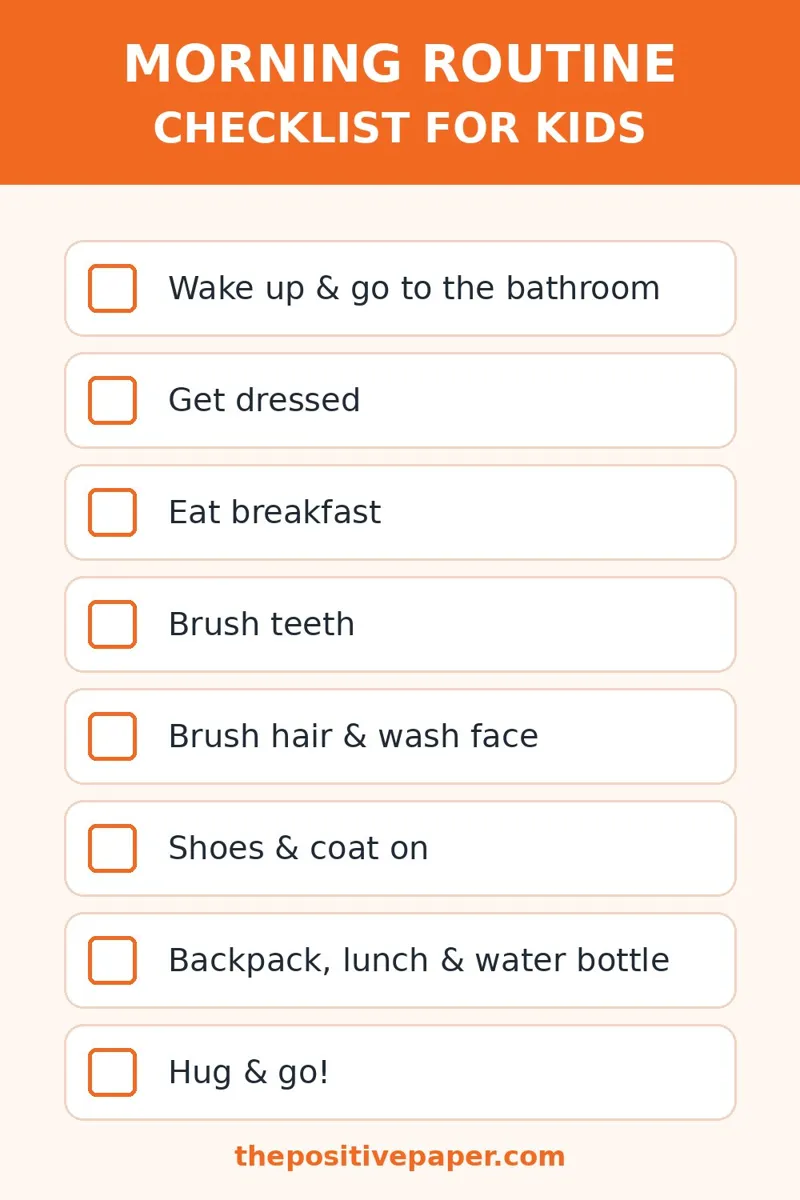
Print it large, add a picture for each step for younger children, and stick it at your child’s eye level where the task happens: the clothes step in the bedroom, the teeth step in the bathroom.
Australia’s Raising Children Network also suggests turning the routine into a game, like “beat the buzzer,” and praising cooperation the moment you see it rather than only commenting when things go wrong.
Our advice: keep screens off until your child is completely ready to leave, if you allow them at all. Turning off a show to put on shoes is one of the most common morning flashpoints. Raising Children Network recommends cutting distractions like TV and tablets in the morning, unless screen time is a treat for being ready on time.
If screens are already a daily battle in your home, read how to set screen time limits without a fight every day, or try our 30-day plan, 30 Days to Screen-Savvy Kids.
Use a visual timer so time is something they can see. Stop repeating instructions; point to the chart instead. “When you’re dressed, then you can have breakfast” works better than a fifth reminder.
Move the decision to the night before and offer two choices, not open-ended ones. When a meltdown happens anyway, stay low and slow. These 20 things to say instead of “calm down” help in the moment.
Stagger the bathroom by 10 minutes and give each child their own spot for shoes and bags. Fewer shared spaces mean fewer collisions.
Get up 15 to 20 minutes before your kids so you start the morning ahead, not behind. If shouting has become your default, our 6-step method to stop yelling at your kids is a good place to begin, and 21 Days to Calmer Parenting walks you through it day by day.
Occasional reluctance is normal. Regular tears, stomachaches or refusing to leave the house are worth taking seriously. Talk to the teacher about what’s happening at school, and speak with your pediatrician, as ongoing school refusal can be linked to anxiety or other problems that need more support than a routine can give.
Children with ADHD, autism, anxiety or sensory differences often find a standard morning routine for kids harder to follow. Visual schedules are widely used to help, and breaking each step into smaller ones (“socks, then pants, then shirt”) can make a big difference. A “first, then” approach helps too: first teeth, then the favorite cereal. If mornings are a daily struggle, ask your pediatrician or your child’s support team to help you build a plan that fits your child.
Children borrow our calm, and they borrow our panic too. Ten quiet minutes before the house wakes up, coffee ready, your bag packed, changes the tone of the whole morning. If you’re running on empty most days, start with how to be a calm parent, and if exhaustion is the real problem, our 7-day reset for mom burnout is written for you. A short positive affirmation for your child at the door is a nice way to end the routine on a good note.
Work backwards from when you leave and from how much sleep your child needs. For a typical 7:45–8:00 a.m. departure, most school-age children wake between 6:30 and 7:00, which only works if they’re asleep 9 to 12 hours earlier.
For school-age children, 45 to 60 minutes from waking to leaving is usually enough. Preschoolers often need 60 to 75 minutes, because everything takes longer with small hands.
Many children aged 7 to 9 can follow a written checklist with a couple of check-ins, and most 10- to 12-year-olds can run the whole routine themselves. Every child is different, so build independence one step at a time.
Small rewards help a new routine get going. Fade them after a few weeks so the habit carries itself, and keep the praise specific: “You got dressed before breakfast all by yourself.”
Give any new routine about two weeks before you judge it. The first few days are usually the hardest, and changing the plan too early teaches kids that pushing back works.
A routine gives your mornings structure. The way you respond when it wobbles is what makes it stick. If you want more practical, step-by-step help, browse our self help ebooks for parents, including 21 Days to Calmer Parenting and Raise an Unstoppable Child, a 30-day plan for raising resilient children.
About the author: Tommy Kirk is the author behind The Positive Paper’s self help ebooks for parents, with 10,000+ sales on Amazon. He writes short, practical guides that busy families can use the same day.
This article is general parenting information, not medical advice. Sleep recommendations come from the American Academy of Sleep Medicine, endorsed by the American Academy of Pediatrics. If your child has ongoing problems with sleep, anxiety or going to school, please speak with your pediatrician. Last reviewed: October 20, 2026.







 16Sep
 21Sep
 28Sep
 01Oct
 02Oct
 05Oct
 by